

 中文简体
中文简体A panel that reads as woven metal from one side and clear glass from the other is rarely a printed imitation. In almost every case it is laminated mesh glass: two panes of glass bonded around a woven mesh interlayer with a transparent bonding film, fused under heat and pressure. The product is best understood as a laminated safety glass with a decorative core, not a surface finish. That distinction drives every practical decision that follows — how the panel is built, how it behaves when broken, and what a buyer should confirm before placing an order.
What Is Laminated Mesh Glass?
Laminated mesh glass is a multi-layer glass composite that encloses a woven mesh — typically metal, though synthetic or fiber mesh is also used — between two or more panes of glass. A bonding film made of PVB, EVA, or SGP sits between each ply, softens during the lamination process, and welds the stack into a single unit. Because the mesh is fully buried inside the composite, it is protected from cleaning chemicals, humidity, and physical contact on both faces.
How It Differs from Traditional Wired Glass
Buyers often confuse this product with the old "wired glass" that appears in industrial and fire-rated openings. Traditional wired glass has mesh cast into a single annealed pane during production, so it holds broken pieces in place but can still release sharp fragments under heavy impact. Laminated mesh glass is a different family: the mesh is a separate interlayer, and the outer panes can be tempered, heat-strengthened, or annealed. For doors, partitions, and shower enclosures, tempered or heat-strengthened substrates provide far safer breakage behavior.
How Laminated Mesh Glass Is Put Together
The Interlayer Decides Long-Term Performance
The key conclusion here is simple: the interlayer film controls the panel's long-term behavior more than the mesh does. PVB remains the default for architectural glazing because it is proven, optically clear, and dimensionally stable. EVA is common in decorative mesh work because it flows around the weave and bonds reliably to wires and fabrics without trapped air. SGP is the stronger choice, with higher stiffness and better load transfer — a relevant advantage for oversized panels, overhead glazing, and security-rated assemblies.
| Characteristic | PVB | EVA | SGP |
|---|---|---|---|
| Typical film layer thickness | 0.38 or 0.76 mm | 0.38 or 0.76 mm | 0.89, 1.52, or 2.28 mm |
| Optical clarity | Good | Good | Excellent |
| Adhesion to metal mesh and textiles | Moderate | Very good | Good |
| Moisture and edge stability | Good | Good | Very good |
| Impact and load performance | Good | Good | High |
| Typical use in mesh glass panels | Architectural glazing and doors | Decorative and curved panels | Oversized or security-rated panels |
Fabricators do not treat these films as interchangeable. MD Glass, a Chinese glass processor and shower-room manufacturer with more than 17 years of experience, supplies this family and offers wired laminated glass in multiple film types, thicknesses, and dimensions. For a specifier, that breadth is useful because the same mesh can be laminated with PVB for standard interior conditions or with EVA and SGP when adhesion and structural margin are the priorities.
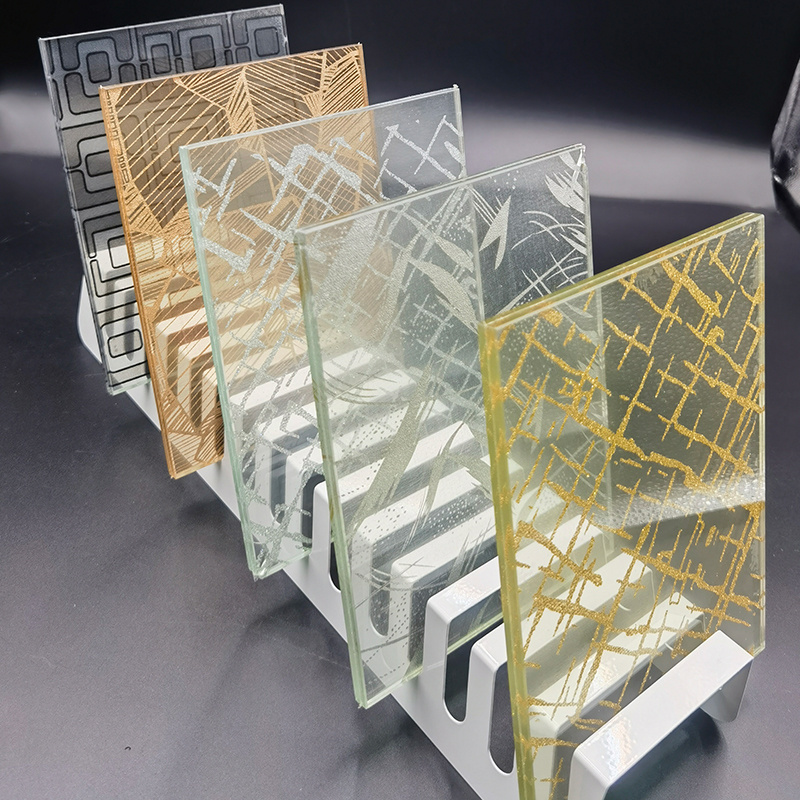 Custom PVB/EVA/SGP film thickness and size, various textures, wired laminated glAs China Custom PVB/EVA/SGP film thickness and size, various textures, wired laminated glass Manufacturers And PVB/EVA/SGP film thickness...View Product →
Mesh, Substrate, and Texture Options
The visual character comes from the mesh, but the feel of the panel comes from the substrate. Stainless steel, copper, brass, or coated wire in different openness ratios controls how much light passes and how clearly a silhouette is visible. The two outer panes do not need to match: a clear pane on the outside and a tinted pane on the inside changes the daylight balance, while a patterned base such as fluted, pear-textured, or water-textured glass adds softness. If the substrate decision is still open, a practical guide to choosing glass offers a structured framework for clear versus tinted versus patterned options before the mesh is added to the stack.
Where Laminated Mesh Glass Earns Its Place
Interior Partitions and Doors
Interior partitions are the most common application. The woven interlayer creates privacy without blocking daylight, and because the panel is laminated, it behaves predictably in corridors and meeting rooms where people push, lean, or move equipment near the glass. A tempered mesh partition is also simple to clean, which gives it an advantage over fabric-covered or film-treated alternatives in high-traffic interiors.
Backlit Walls and Feature Panels
Backlighting is where the product becomes a real design statement. When light is placed behind the panel, the weave casts its own shadow pattern and the glass gains a depth that daylight alone cannot show. Hotel lobbies, reception walls, stairwells, and restaurant interiors use the effect widely. What buyers often underestimate is the optical requirement: the interlayer must be even in thickness, the mesh must be tensioned consistently, and the lighting layout must avoid bright spots that expose small variations in the weave.
Bathroom and Shower Environments
Mesh laminated glass is also moving into bathrooms as decorative shower screens, room dividers, and glazed panels. The selection logic is stricter there because humidity and soap residue attack exposed edges, so film type and edge finishing deserve extra attention. For anyone evaluating a decorative interlayer in a wet area, this review of whether PVB embossed decorative glass is safe for shower doors explains why edge protection and substrate selection matter; the same reasoning applies to mesh panels.
A Practical Specification Checklist
Lock Down the Interlayer Before the Mesh
Most specification mistakes happen when the decorative layer is selected first and the engineering film second. Start with the service environment: outdoor or humid locations demand stronger moisture resistance, oversized panels demand stiffer films, and backlit panels demand even clarity. Acoustic behavior is a separate decision — the stiffness and thickness of the film influence sound insulation, but not in a simple linear way, and the mesh itself changes the result. When noise control matters, how interlayer materials used in wired laminated glass affect sound insulation performance is worth reviewing before choosing between PVB and SGP.
Think About Light and UV Before Locking the Sample
The same mesh over different glass can look like a completely different product. Clear panes maximize daylight; colored panes reduce glare and solar heat gain. When a project also carries a radiation or ultraviolet requirement, the film itself can handle the task — an EVA and PVB film in radiation-resistant colored laminated glass places the protective function inside the panel instead of relying on a coating alone. Always keep a physical sample of the full stack — mesh, film, and substrate — because printed photos cannot reproduce how the panel behaves when light passes through it.
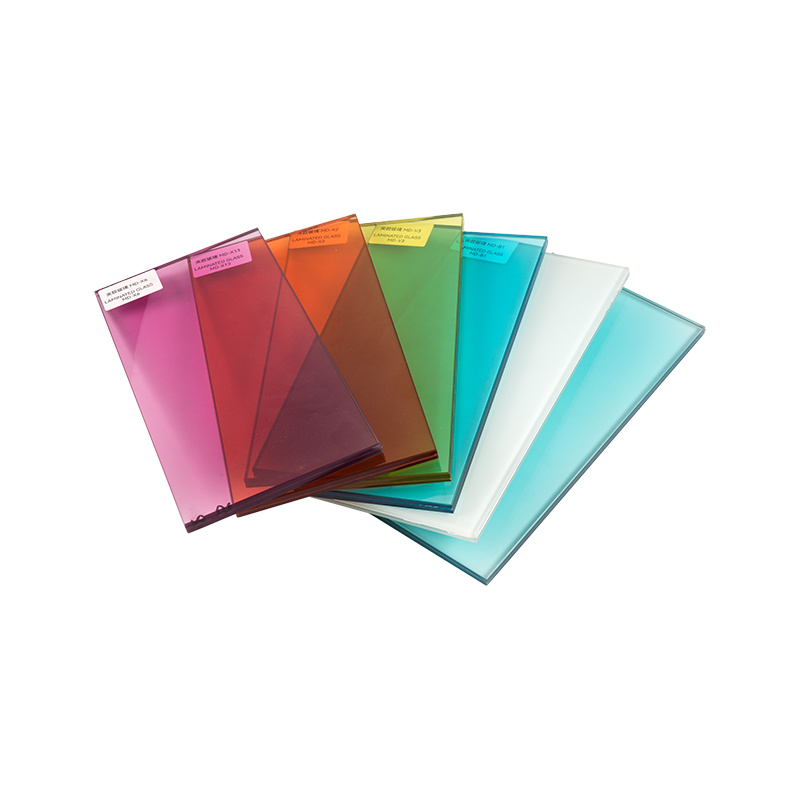 Custom EVA and PVB film colors available Radiation-proof colored laminated glassAs China Custom EVA and PVB film colors available Radiation-proof colored laminated glass Manufacturers And EVA and PVB film colors avail...View Product →
Check Tolerances and Edge Finishing
Mesh laminated panels are finished, cut-to-size products, and the quality of the fabrication shows at the edges. The minimum confirmed set of information should cover:
- Finished dimensions and permissible thickness tolerance
- Glass type and thickness for each ply
- Interlayer film and mesh pattern
- Hole, notch, and edge-finish requirements
Edge chips are the most common entry point for moisture and the leading cause of field delamination. If holes or hardware notches are required, they should be drawn before production begins; adding them later is costly and can compromise the edge seal.
Match the Supplier to the Risk
Because a mesh panel is a composite, the buyer is auditing a process, not picking a stock item. Confirm what certifications the factory holds, how it controls glass cleaning, interlayer conditioning, autoclave cycles, and edge inspection, and how it reports reject rates. MD Glass operates a 20,000-square-meter plant in Zhejiang Province, with an annual output of 50,000 tons of tempered glass, and supports exports with China 3C and European CE certification plus SGS reports for common thicknesses such as 4 mm, 5 mm, 6 mm, and 8 mm. The factory's location near the Shanghai and Ningbo ports shortens sea-freight lead times for international buyers — a practical advantage when mesh panels sit on a project's critical path.
Laminated mesh glass rewards buyers who treat it as an engineered composite. Define the interlayer first, decide the substrate next, confirm the mesh pattern and openness, and audit the supplier's process control before ordering. When those variables are clear, the panel delivers what printed film cannot: a durable, light-filtering surface with the mesh genuinely embedded inside a safe glass build. Specified properly, it will look the same five years after installation as the day the samples were approved.