

 中文简体
Textured shower glass sells itself the moment a client stands beside an installed shower door and sees how a fluted surface turns the person inside into a silhouette instead of a picture. The practical appeal runs deeper: an embossed surface hides the water spots that make clear glass look neglected after three days, and the pattern adds a tactile layer to a material that is otherwise a flat, cold plane. Choosing the right textured shower glass still comes down to three variables that buyers routinely confuse: pattern depth, glass thickness, and how the texture was produced. Get those right and the enclosure performs for years; get them wrong, and you will notice it every single shower.
Textured Shower Glass: Definition, Process, and Performance
Textured shower glass is fully tempered safety glass whose surface has been permanently embossed, sandblasted, or acid-etched to scatter transmitted light and reduce visual clarity.
The texture is not a film and not a printed pattern. In rolled patterned glass, the texture is pressed into the molten ribbon as it leaves the forming rollers, so the pattern is an integral part of the sheet. In sandblasting, abrasive grains remove a thin layer from the finished sheet and produce the frosted look that most people call matte glass; acid etching achieves the same result at a finer scale. All three methods stay compatible with tempering only when the surface work happens before the heat-treatment stage. Texturing after tempering scratches the surface and leaves stress marks that can initiate cracks under impact.
Key definition: textured shower glass is tempered glass with an integral surface pattern, formed by rolling, sandblasting, or etching, that scatters light and softens images while keeping the panel safe for a wet enclosure.
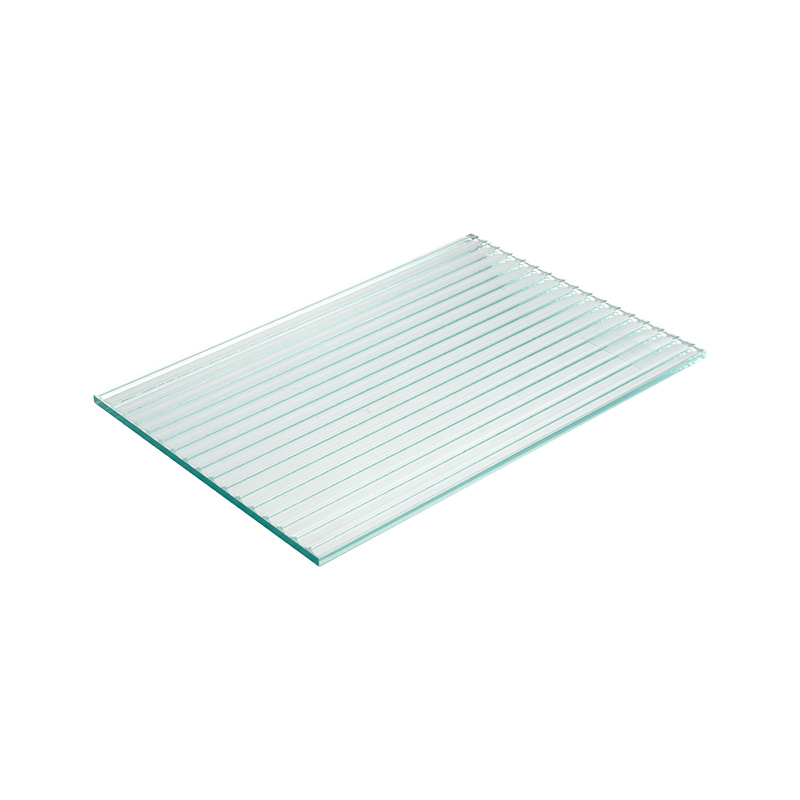 Narrow Reeded Corrugated Fluted Glass 4-10mm for Showers and DecorThis fluted glass with narrow reeded or corrugated patterns offers translucent light diffusion and privacy, suitable for shower partitions and decorative panels where pattern depth is the key comparison factor.View Product →
Textured Shower Glass Patterns: Privacy and Light Compared
Pattern choice drives about 80 percent of the privacy result, and pattern depth, not the commercial name, is the number to compare between factories.
Five pattern families cover most residential and hotel shower projects: fluted (reeded) vertical ribs, water-like ripples, pear (Nashiji) speckles, cloth-textured woven lines, and sandblasted or frosted glass. They differ in privacy, light transmission, and upkeep.
| Pattern | Production method | Privacy score | Light transmission |
| Fluted / reeded (vertical ribs) | Rolled embossing | 55 out of 100 | About 88% of clear glass |
| Water-like (irregular ripples) | Rolled embossing | 65 out of 100 | About 84% of clear glass |
| Pear / Nashiji (fine speckle) | Rolled embossing | 72 out of 100 | About 83% of clear glass |
| Cloth-textured (woven lines) | Rolled embossing | 88 out of 100 | About 79% of clear glass |
| Sandblasted / frosted | Abrasive or acid erosion | 95 out of 100 | About 72% of clear glass |
Pattern depth is the spec that matters: ribs deeper than 1 mm block more light but collect more soap film, while 0.4-0.6 mm depths give the best privacy-to-maintenance balance for residential showers.
Safety and Thickness: Why Texture Does Not Replace Tempering
Texture is a decorative surface treatment, not a structural feature; textured shower glass only satisfies enclosure safety requirements when the finished panel is fully tempered.
Shower enclosures are human-sized sheets of glass mounted within arm's reach of elbows, soap dishes, and children, so nearly every building code treats them as safety glazing. A fully tempered 6 mm panel breaks into small rounded particles on impact; an annealed panel of the same size breaks into long, knife-edge shards. A production-grade example helps define the standard: Zhejiang MingDing Glass Technology Co., Ltd. (MD Glass), a Chinese glass processor in Shangyu, Zhejiang, has tempered patterned glass since 2006, runs roughly 50,000 tonnes of annual tempered output, and ships shower glass lines with China 3C and European CE certification.
Thickness follows the door type, not the texture. For framed enclosures, spec 6 mm glass. For frameless doors, where the panel carries the hinges, spec 8 mm. For panels wider than about 900 mm, step up to 10 mm.
- 6 mm is the standard for framed shower screens and sliding doors.
- 8 mm is the default for frameless doors and pivot hinges.
- 10 mm is recommended for wide spans or openings above 2 m.
The deeper question, whether embossed decorative glass is safe inside a shower door, matters when a designer prefers a laminated texture for extra sound or sparkle. Laminated glass can be used safely when the construction is tempered glass plus a PVB interlayer; plain annealed decorative panels should stay out of the wet zone.
Ordering rule: confirm the tempering certificate for the exact thickness you buy, check edges before installation, and reject any textured panel with visible edge chips before it goes near a shower.
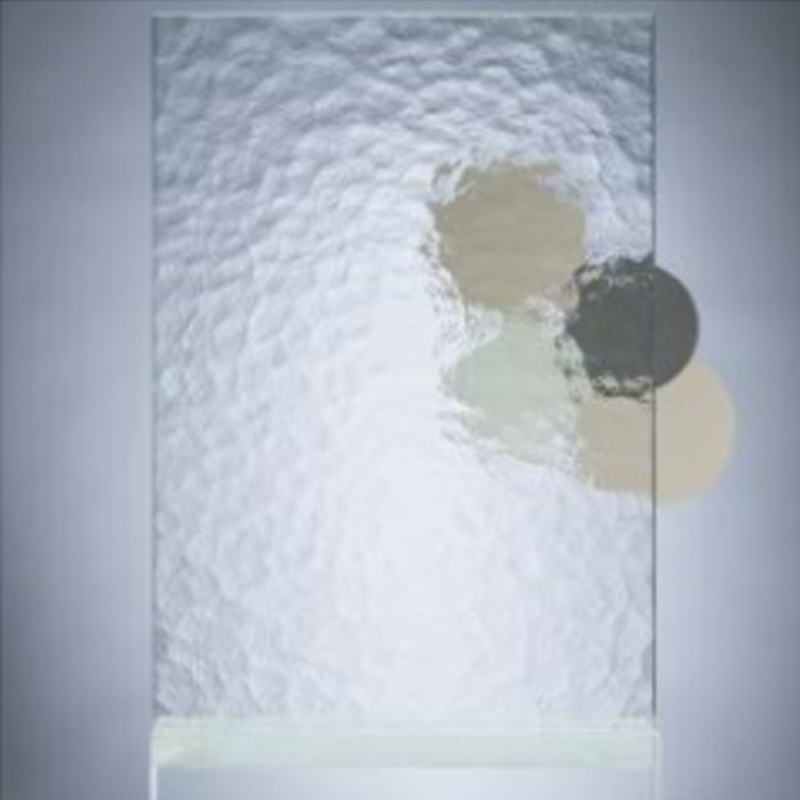 Water Textured Embossed Glass in 4-8mm Thickness for Cabinets and PartitionsWith a permanent water-like embossing, this glass balances translucency and privacy while creating gentle light effects. Its texture suits cabinet doors and partitions, though the pattern can grip soap film, so routine maintenance is needed.View Product →
Maintenance by Texture: What Actually Stays Clean
The same texture that hides water spots also gives soap film a surface to grip, so the practical move is to pick a medium-depth rolled pattern and accept a 30-second squeegee routine, not to buy the deepest texture and hope it stays clean by itself.
Frosted and sandblasted
Highest privacy, highest upkeep. Abrasive texturing leaves micro-porosity that grabs soap film and hard-water minerals. Plan a weekly clean with a pH-neutral spray and a soft sponge, and never use abrasive pads or metal scrapers on the matte side.
Rolled patterns (fluted, water, pear)
Moderate privacy, lower upkeep. The embossing sheds water along vertical or irregular lines, so a daily squeegee keeps the panel presentable for months. Medium-depth ribs of 0.4-0.6 mm hide spots without creating pores that trap dirt.
The cleaning routine for any textured shower glass is short when it is consistent:
- Run a squeegee across the panel after every shower, especially on the textured side facing the room.
- Use a pH-neutral cleaner or plain warm water with a microfiber cloth for weekly wipe-downs.
- Avoid acidic descalers on sandblasted or acid-etched surfaces; they dull the matte finish over time.
- In hard-water regions, a water softener reduces film build-up on every texture, rolled or matte.
Realistic expectation: a textured panel in a shared family bathroom stays presentable with a daily 30-second squeegee and a monthly deep clean; clear glass with the same routine looks cleaner when freshly wiped, but textured glass hides the streaks between cleans.
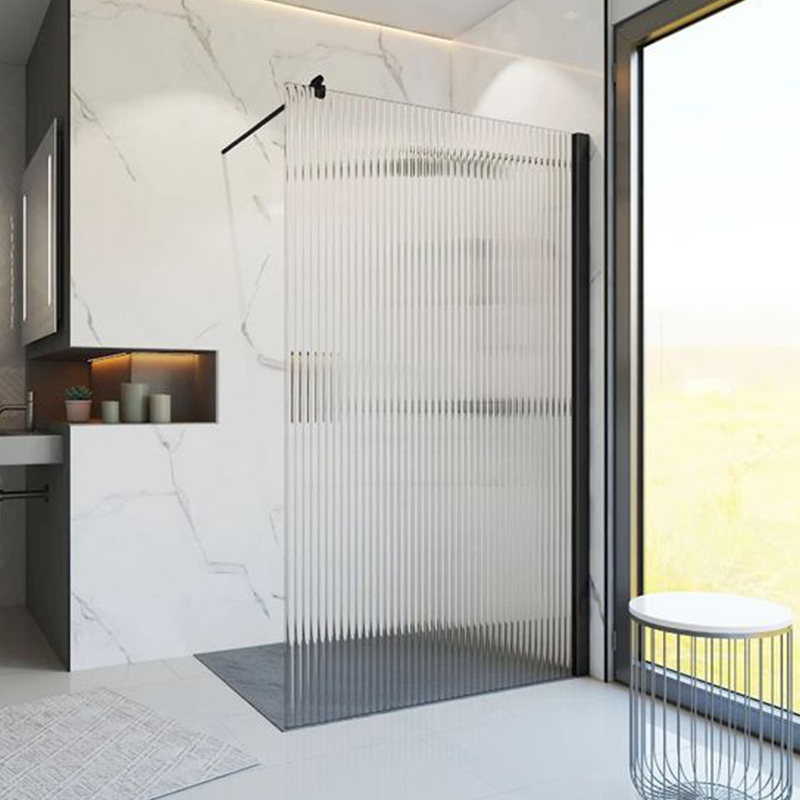 Customizable Textured Shower Screen for Wet-Dry SeparationThis transparent shower screen allows personalized texture designs while keeping water contained, preserving an open bathroom feel. Choose your preferred pattern to match the dry and wet zones, with customization options from the manufacturer.View Product →
What to Specify When Sourcing Textured Shower Glass
Sourcing textured shower glass is a specification exercise: confirm production method, tempering, edge finish, sampling, and batch traceability in writing before you place an order.
Work through these five points with the factory, and the chance of a mismatched or unsafe delivery drops close to zero.
- Specify the pattern family and the target texture depth in millimetres, not just the pattern name; names such as water-like or pear vary between factories, but depth is measurable.
- Require full tempering and a copy of the 3C or CE certificate that covers your exact thickness; the certificate must name glass, not just a product family.
- Ask for a cut sample around 200 x 200 mm produced on the same line, one that you hold against bathroom light before approving a bulk order.
- Define edge work: flat polished edges for framed doors, beveled or pencil-polished edges for frameless doors, because texture makes edge chips far more visible than clear glass.
- Confirm dimensional tolerance and batch consistency; for a 900 mm frameless panel, plan for about plus or minus 1.5 mm, and require that all panels in one order come from the same production batch so the pattern matches.
17+years of glass processing experience
50,000 tannual tempered glass output
20,000 m2factory area close to Shanghai and Ningbo ports
3C, CE, SGScertifications covering shower glass lines
Supply chain note: MD Glass delivers textured glass as raw tempered panels or as finished shower screens with aluminum frames, hinges, and pulleys from its own accessory line. Decide which level of supply you need, because a finished-screen order shifts the tolerance and hardware responsibility to the factory.
Frequently Asked Questions About Shower Glass
Does textured shower glass provide enough privacy?
Yes, at the levels shown in the comparison table. Fluted and water-like patterns blur outlines and suit bathrooms where the shower is used by one person at a time; cloth-textured and frosted panels hide details almost completely and work better in family bathrooms and hotel rooms. Lighting matters as much as the pattern: a bright shower area against a dark bathroom still reads as a silhouette.
What thickness should a textured shower screen use?
Use 6 mm for framed enclosures, 8 mm for frameless doors, and 10 mm when the panel spans more than about 900 mm. The glass must be fully tempered, and frameless doors need hinges and clamps rated for the panel size and weight.
Will textured shower glass show water spots?
Less than clear glass, but texture does not repel water. Rolled patterns hide spotting because the ribs scatter reflections, while sandblasted surfaces hide spotting even better but absorb soap film and need more aggressive cleaning. A daily squeegee and a pH-neutral spray keep any texture presentable.
Can any textured glass be tempered?
Most can, when the texturing is done before tempering. Rolled patterned glass is embossed while molten and then goes through the tempering furnace as a normal step. Sandblasting and acid etching must also be completed before heat treatment; texturing after tempering leaves stress marks that reduce panel strength. Confirm the process sequence with your processor and request the tempering certificate with the delivery.
Bottom line: the most popular specification for textured shower glass is a 0.4-0.6 mm rolled pattern, 8 mm fully tempered, with polished edges, a sample approved under bathroom light, and a printed certificate for the batch delivered.