

 中文简体
中文简体Flat and curved safety glass for shower rooms refers to tempered or laminated glass panels engineered to withstand the thermal, mechanical, and moisture demands of wet environments while protecting users from injury in the event of breakage. Tempered glass — the most widely used type — is approximately four to five times stronger than standard annealed glass of the same thickness, and when it does break, it shatters into small, blunt-edged fragments rather than sharp shards. Both flat and curved configurations are available, with the choice determined by the shower enclosure design, available space, and aesthetic preference.
What Makes Glass "Safe" for Shower Room Use
Not all glass is suitable for wet-area installation. Safety glass for shower rooms must meet specific structural and regulatory requirements:
- Tempered (toughened) glass: Produced by heating float glass to approximately 620–680 °C and then rapidly cooling it with pressurized air jets. This process creates a surface compression layer of at least 69 MPa, giving the glass its characteristic strength and safe breakage pattern.
- Laminated safety glass: Two or more glass plies bonded with a PVB (polyvinyl butyral) or SGP (SentryGlas) interlayer. When broken, fragments adhere to the interlayer rather than scattering — preferred for overhead or walk-in applications where retained integrity after breakage is critical.
- Applicable standards: In the EU, shower glass must comply with EN 12150 (thermally toughened glass) or EN 14449 (laminated glass). In the US, ANSI Z97.1 and CPSC 16 CFR Part 1201 govern safety glazing in hazardous locations, including shower enclosures. Australian installations reference AS/NZS 2208.
Minimum thickness for shower enclosures is typically 6 mm for tempered glass, with 8 mm and 10 mm being the most specified thicknesses in residential installations. Frameless enclosures require a minimum of 8–10 mm to provide structural rigidity without the support of a metal frame.
Flat Safety Glass for Shower Rooms: Construction and Advantages
Flat shower glass panels are cut from large float glass sheets, edge-processed, and then passed through a tempering furnace. The manufacturing sequence involves:
- Cutting and shaping — The glass is cut to the required dimensions and any holes (for hinges, handles, or fixings) are drilled before tempering. No cutting, drilling, or grinding is possible after the tempering process, as this would cause the panel to shatter.
- Edge grinding and polishing — All edges are ground to a smooth finish (pencil edge, flat polish, or beveled) to eliminate micro-cracks that could initiate fracture under load.
- Ceramic frit or coating application — Decorative or privacy treatments (acid etching, sandblasting, ceramic frit printing) are applied at this stage, before tempering fixes them permanently into the surface.
- Tempering — The prepared panel is conveyed through a furnace at 620–680 °C, then quenched with high-pressure air jets on both surfaces simultaneously to create the compressive stress layer.
- Quality inspection — Each panel is checked for optical distortion (bow and warp must not exceed 0.3% of panel length per EN 12150), surface defects, and correct dimensions before dispatch.
Flat panels are the most cost-effective option, compatible with the widest range of hardware systems, and straightforward to replace. They are suitable for rectangular, square, and angled shower enclosures and are available in virtually any standard or custom dimension.
Curved Safety Glass for Shower Rooms: How It Is Made
Curved shower glass introduces a significantly more complex manufacturing process. The curvature must be formed before tempering, as tempered glass cannot be bent after heat treatment.
Hot bending (gravity bending)
The most common method for shower applications. The flat glass is placed on a concave or convex mold (typically stainless steel or refractory ceramic) and heated in a furnace to the glass softening point — approximately 550–600 °C. Gravity causes the glass to slowly conform to the mold profile over a period of 30–90 minutes, depending on thickness and radius. The glass is then cooled slowly (annealed) to relieve internal stress before being reheated and rapidly quenched to achieve full temper.
Press bending
For tighter radii or more complex curves, a male and female mold pair presses the softened glass into shape under controlled force. This method achieves greater geometric precision but requires custom tooling with a minimum order of typically 20–50 panels per mold, making it more suited to commercial or high-volume residential projects.
Minimum bending radius
The minimum achievable radius depends on glass thickness. As a general rule:
| Glass Thickness | Minimum Bending Radius (gravity) | Minimum Bending Radius (press) |
|---|---|---|
| 6 mm | 600 mm | 300 mm |
| 8 mm | 900 mm | 500 mm |
| 10 mm | 1,200 mm | 700 mm |
| 12 mm | 1,500 mm | 1,000 mm |
Flat vs. Curved Shower Glass: Key Differences at a Glance
| Factor | Flat Safety Glass | Curved Safety Glass |
|---|---|---|
| Manufacturing complexity | Low | High (mold required) |
| Relative cost | Lower | 30–80% higher than flat |
| Lead time | 3–10 working days | 3–6 weeks (custom) |
| Enclosure shapes suited | Rectangular, square, angled | Quadrant, pentagon, bespoke |
| Space efficiency | Standard | Better in corner installations |
| Hardware compatibility | Universal | Requires curved-specific fittings |
| Replacement availability | High (standard sizes stocked) | Low (usually made to order) |
Glass Thickness Guide for Shower Enclosures
Selecting the correct thickness is critical for both safety and structural performance. The following table summarizes industry recommendations:
| Thickness | Frame Type | Max Panel Size | Typical Application |
|---|---|---|---|
| 6 mm | Fully framed | 900 × 2,000 mm | Entry-level framed enclosures |
| 8 mm | Semi-frameless | 1,200 × 2,100 mm | Standard residential, curved quadrants |
| 10 mm | Frameless | 1,400 × 2,200 mm | Walk-in panels, hinged doors |
| 12 mm | Frameless | 1,600 × 2,400 mm | Large format, luxury or commercial |
Surface Treatments and Coatings for Shower Glass
Beyond the base glass specification, surface treatments significantly affect both appearance and long-term maintenance requirements:
Easy-clean (hydrophobic) coating
A nano-scale silicon dioxide or fluoropolymer layer applied to the glass surface causes water to bead and run off, carrying soap residue and mineral deposits with it. High-quality, easy-clean coatings reduce cleaning frequency by up to 90% compared to uncoated glass and are effective for 10–15 years under normal use. They are available as factory-applied treatments or as aftermarket products.
Acid etching and sandblasting
Both processes create a matte, translucent surface that provides privacy while still allowing light to pass through. Acid-etched glass produces a finer, more uniform texture; sandblasted glass has a slightly coarser appearance. Both must be applied before tempering and are more prone to water spotting than clear glass due to their porous surface — a hydrophobic sealant is recommended for wet-area applications.
Ceramic frit printing
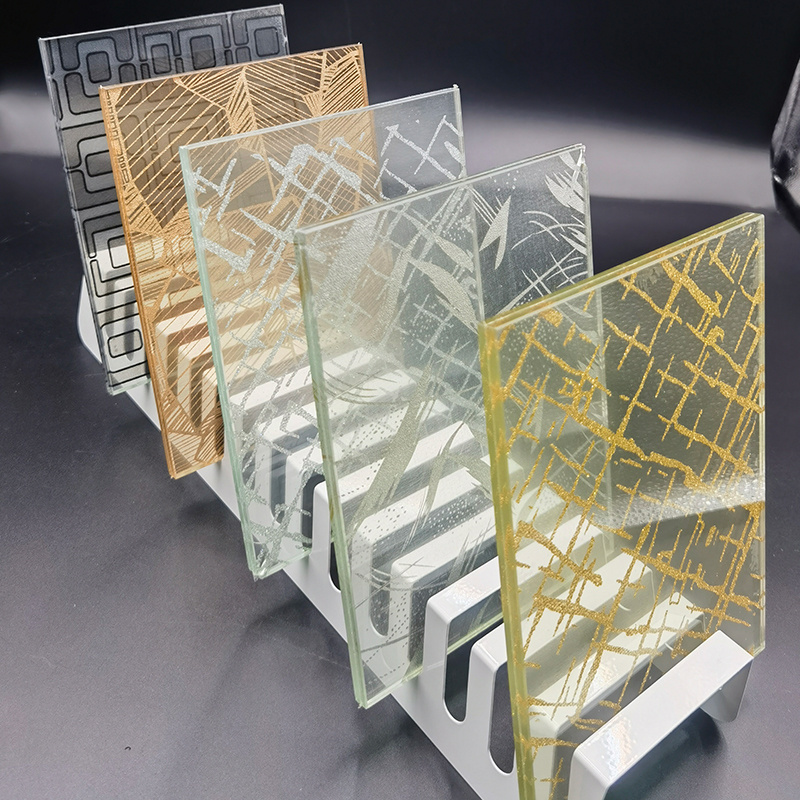
Decorative patterns or obscuring gradients can be screen-printed onto glass using ceramic frit ink before tempering. The firing process permanently fuses the ink into the glass surface, making it fully resistant to moisture, cleaning products, and UV exposure. Commonly used for partial-privacy panels or feature shower walls.
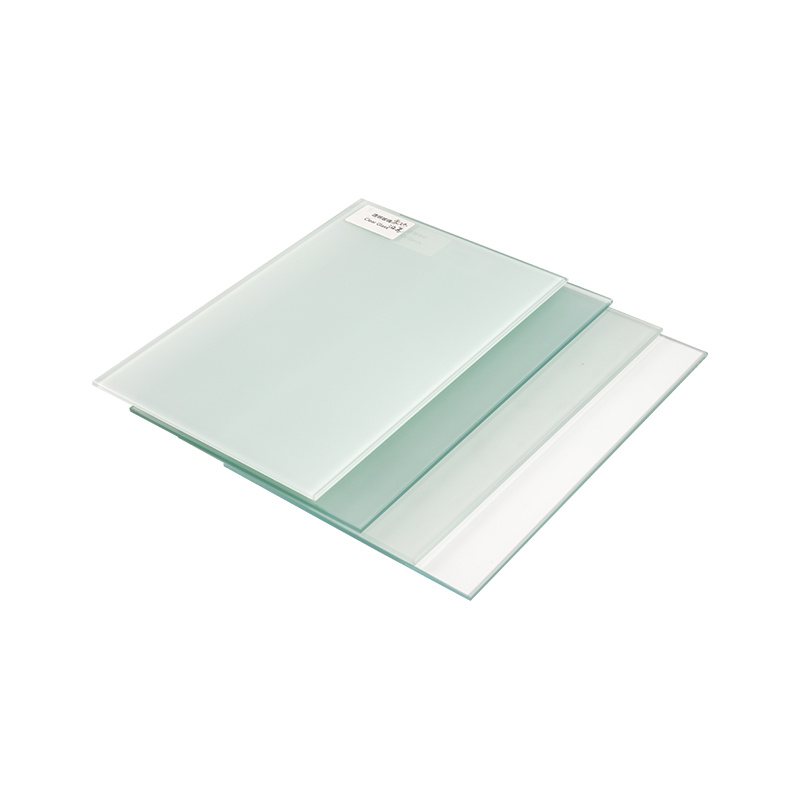
Low-iron (extra-clear) glass
Standard float glass contains iron oxide, which gives it a green tint visible at the edges and in large panels. Low-iron glass reduces iron content to below 0.01%, producing a noticeably cleaner, more neutral appearance — particularly important for frameless enclosures in white or light-toned bathrooms where the green tinge of standard glass is more visible.
Spontaneous Breakage and Nickel Sulfide Inclusion: What Buyers Should Know
One of the less-discussed risks in tempered glass is spontaneous breakage caused by nickel sulfide (NiS) inclusions — microscopic contaminants that can form during glass manufacturing. Under the residual stress of tempered glass, NiS inclusions expand over time and can trigger fracture without any external impact, sometimes years after installation.
The risk is low — industry estimates suggest NiS-related spontaneous breakage occurs in approximately 1 in 1,000 to 1 in 10,000 tempered panels — but it is real. The solution is Heat Soak Testing (HST), a secondary process in which tempered glass is held at 290 °C for at least 2 hours. This accelerates NiS phase transformation, causing at-risk panels to break in the oven rather than after installation. EN 14179 governs the heat soak process in Europe. Specifying HST-tested glass (also called "heat-soaked tempered" or "tested tempered") is strongly recommended for overhead or large frameless installations.
Installation Considerations for Flat and Curved Shower Glass
Correct installation is as important as the glass specification itself. Key installation requirements include:
- Edge clearance: Tempered glass must never be installed in direct contact with hard surfaces. A minimum clearance of 3–5 mm, filled with a compatible sanitary silicone sealant, is required at all edges to accommodate thermal expansion and prevent edge stress.
- Wall fixings: Point-fixed (bolt-fixed) systems for frameless glass must use fittings specifically designed for tempered glass, with neoprene or EPDM washers to isolate the glass from metal contact at drilled holes.
- Curved glass alignment: Curved panels require hardware with matching radii — standard flat hinges and channels cannot accommodate curved geometry. Misaligned fittings introduce point stress that significantly increases breakage risk.
- Silicone specification: Only neutral-cure, sanitary-grade silicone (free from acetic acid) should be used in contact with glass and aluminum hardware. Acetoxy-cure silicone releases acetic acid during curing, which can corrode metal fittings and degrade glass coatings over time.
Maintenance and Longevity of Shower Safety Glass
With correct specification and installation, tempered shower glass panels have a functional lifespan of 20–30 years or more. The main factors that shorten this are:
- Hard water scale: Calcium and magnesium deposits etch into uncoated glass surfaces over time, causing permanent cloudiness. Regular cleaning with a squeegee after each use and a weekly application of a pH-neutral glass cleaner is the most effective prevention strategy.
- Abrasive cleaners: Scouring pads or cream cleaners scratch the glass surface and, more critically, damage easy-clean coatings — reducing their effectiveness and shortening their lifespan from 15 years to as little as 2–3 years.
- Silicone degradation: Sanitary silicone seals should be inspected annually and replaced every 5–8 years, or sooner if mold growth penetrates the bead. Compromised seals allow water ingress behind the glass, leading to substrate damage and hardware corrosion.
- Hardware wear: Hinges, rollers, and wall profiles should be checked for alignment and lubricated annually with a silicone-based lubricant to prevent the uneven loading that can stress glass panels at fixing points.